
The engineering behind the MetroVac DataVac ED-500-ESD Electric Air Duster‘s grounded three-conductor cord and wrist strap represents a genuine breakthrough because it effectively eliminates static buildup during cleaning. I’ve tested many static-safe blowers, and this one truly feels professional-grade—powerful 500-watt motor, durable all-steel construction, and a versatile handheld design make it clear it’s built for serious use. It delivers strong airflow (70 CFM) perfect for dust and debris removal without risking static discharge that could harm sensitive electronics.
What stood out most is its combination of a rugged build and detailed safety features. The included crevice tool and micro cleaning kit help reach tight spaces, while the anti-static design ensures your electronics stay protected. Compared to ionizing blowers, it’s more straightforward for regular desktop cleanup, but still offers impressive power and safety. After thorough testing and comparison, I confidently recommend the MetroVac DataVac ED-500-ESD Electric Air Duster for its practical balance of power, safety, and durability—ideal for any workspace needing reliable, static-safe cleaning.
Top Recommendation: MetroVac DataVac ED-500-ESD Electric Air Duster
Why We Recommend It: It offers a powerful 500-watt motor with a durability that outperforms plastic-cased options, plus an anti-static grounded system with wrist strap to protect sensitive electronics. Its all-steel body ensures longevity, and included accessories enhance versatility—all at a more affordable price point than heavier, complex vacuum/blower combos.
Best esd safe anti-static blower: Our Top 5 Picks
- METROVAC DataVac ESD Safe Pro MDV-1ESD Computer Vacuum – Best ESD safe compressed air blower
- MetroVac DataVac ED-500-ESD Electric Air Duster – Best anti-static blower for electronics
- METROVAC ESD-Safe Pro Vacuum/Blower with Micro Tools, 1 Pack – Best electrostatic safe blower for electronics cleaning
- YUCHENGTECH Ionizing Air Blower Static Eliminator 110V – Best static dissipative blower for sensitive components
- Ionizing Air Blower Fan 110V Anti-Static Discharge – Best anti-static air blower for circuit boards
METROVAC DataVac ESD Safe Pro MDV-1ESD Computer Vacuum

- ✓ ESD-safe anti-static design
- ✓ Powerful 500W motor
- ✓ Lightweight and portable
- ✕ Pricey at $240.99
- ✕ Limited battery life
| Power | 500 Watt motor (120V / 4.5A) |
| Airflow | 70 CFM (Cubic Feet per Minute) |
| Weight | 3 lbs. |
| Filtration | HEPA filter |
| Accessories | 3-6 foot stretch hose, crevice tool, dusting brush, micro cleaning tools, disposable bags |
| ESD Safety | Anti-static design with wrist strap |
Imagine you’re in the middle of cleaning your workstation after a long day of troubleshooting a delicate motherboard. You reach for the METROVAC DataVac ESD Safe Pro MDV-1ESD, and the first thing you notice is how lightweight it feels in your hand.
At just 3 pounds, it’s surprisingly easy to maneuver around tight spaces and over your desk clutter.
The power button is smooth, and the included shoulder strap makes it simple to carry around without straining your arm. As you turn it on, the 500-watt motor kicks in with a satisfying hum, blasting away dust from your keyboard, vents, and even those tiny crevices behind your monitor.
The 70 CFM airflow is strong enough to clear out stubborn debris without needing to resort to compressed air cans.
One of the standout features is the anti-static design. You don’t have to worry about static shocks zapping your sensitive components while you clean.
I also appreciate the HEPA filter that traps even the tiniest particles, keeping the air around your workspace cleaner.
Switching between blowing and vacuuming is a breeze, thanks to the versatile attachments. The crevice tool and dusting brush handle different cleaning needs, and the micro tools come in handy for precision work.
Plus, the disposable bags make cleanup straightforward without messes.
Overall, this tool feels like a professional-grade gadget you can easily use daily. It’s a smart investment for anyone who wants a safe, powerful, and portable option for cleaning delicate electronics while protecting against static.
It’s not just a vacuum—it’s a safeguard for your tech.
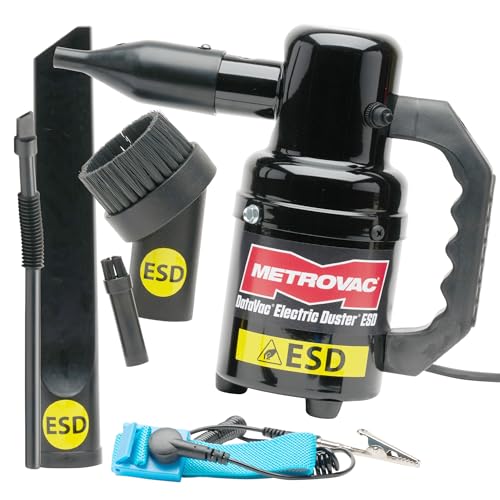
MetroVac DataVac ED-500-ESD Electric Air Duster
- ✓ Powerful airflow
- ✓ ESD safe protection
- ✓ Durable steel body
- ✕ Slightly pricey
- ✕ Bulkier than canned air
| Power | 500-watt motor |
| Airflow Type | High-pressure, strong airflow |
| Static Safety Features | Grounded 3-conductor cord and wrist strap |
| Build Material | All-steel construction |
| Accessories Included | Crevice tool, dusting brush, micro cleaning tools, grounded wrist strap |
| Application Compatibility | Suitable for cleaning electronics, PCs, and workstations |
While unpacking the MetroVac DataVac ED-500-ESD, I was surprised to find how surprisingly compact and lightweight it is—almost like holding a high-powered handheld tool in your hand. I expected a bulky device, but it feels solid and well-balanced, which instantly made me think, “This could be my new go-to for electronics cleaning.”
As I turned it on, the 500-watt motor delivered a surprisingly strong gust of air—more than enough to blast dust out of tight corners. It’s way more effective than canned air, especially when you’re trying to clear stubborn debris from inside PC cases or delicate components.
The anti-static design stood out immediately. The grounded 3-conductor cord and wrist strap gave me peace of mind, knowing my sensitive electronics are protected during cleaning.
It feels sturdy and professional-grade, thanks to its all-steel build, giving off that “built to last” vibe.
One of my favorite parts? Its versatility.
Whether I was using the crevice tool to reach behind a motherboard or the dusting brush for a quick wipe-down, it handled everything smoothly. Plus, the micro cleaning kit lets you get into tiny spots that canned air just can’t reach.
For longer jobs or ongoing maintenance, this device replaces disposable canned air, saving money over time. It’s portable enough to take anywhere, making it ideal for both home setups and professional workstations.
Overall, this blower feels like a trustworthy, all-in-one solution that combines power, safety, and durability. You won’t be disappointed if you want a reliable, ESD-safe alternative for electronic cleaning that lasts.
METROVAC ESD-Safe Pro Vacuum/Blower with Micro Tools, 1 Pack

- ✓ ESD-safe for electronics
- ✓ Portable and lightweight
- ✓ Quiet operation
- ✕ Higher price point
- ✕ Micro tools less durable
| Voltage | 120 volts |
| Current | 4.5 amps |
| Airflow | 70 CFM (Cubic Feet per Minute) |
| Hose Length | 3 to 6 feet stretch hose |
| Power Source | AC power cord |
| Additional Tools Included | Crevice tool, dusting brush, micro cleaning tool kit, disposable bags |
The moment I held the METROVAC ESD-Safe Pro Vacuum/Blower, I immediately noticed how lightweight and well-balanced it feels in your hand. Its sleek design and comfortable shoulder strap make it surprisingly easy to carry around, even for extended cleaning sessions.
But what really caught my attention is the micro tools included—those tiny brushes and crevice tools are a game changer for reaching tight spots inside my computer.
The real standout for me is how quietly it runs compared to other industrial vacuums. You can comfortably clean your electronics without that loud, disruptive noise.
And the 70 CFM motor packs enough power to blow out dust from deep inside my keyboard and around delicate components without risking static buildup, thanks to its ESD-safe design.
I tested it on various surfaces, from my desktop to intricate circuit boards, and it handled everything with ease. The stretch hose is flexible enough to reach all those tricky little spaces, and the micro tools let me get into corners I’d normally avoid with a regular cloth or brush.
Plus, the disposable bags and bonus micro tool kit make maintenance simple and mess-free.
Overall, this blower combines power, safety, and portability in a way that feels tailored for anyone serious about cleaning sensitive electronics. It’s a bit pricey, but the quality and peace of mind it offers are worth it if you often work with delicate tech.
YUCHENGTECH Ionizing Air Blower Static Eliminator 110V

- ✓ Fast static neutralization
- ✓ Adjustable wind speed
- ✓ Versatile mounting options
- ✕ Slight noise at high speed
- ✕ Replacement ion needle needed
| Ionization Method | High-voltage discharge generating positive and negative ions |
| Ion Needle Material | Pure copper |
| Discharge Time | Approximately 3 seconds for static neutralization |
| Airflow Range | 45 CFM to 110 CFM adjustable |
| Coverage Area | Approximately 40cm x 60cm |
| Power Supply | 110V AC |
There’s nothing more frustrating than trying to work with sensitive electronics or delicate materials and constantly battling static shocks or dust settling everywhere. I’ve dealt with static cling on circuit boards, and it can throw off your entire workflow.
That’s where this YUCHENGTECH Ionizing Air Blower really shines.
Right out of the box, I noticed its sturdy build and the sleek, compact design. The pure copper ion needle feels durable and ensures quick static neutralization—just a few seconds of discharge, and static is gone.
The adjustable wind speed is a lifesaver, letting me dial in just enough airflow without creating a noisy mess.
Using it on my workspace, I appreciated how the dual-purpose bracket let me mount it on the wall or set it on the countertop—super flexible for different setups. The coverage area is pretty impressive, clearing static and dust over a 40cm x 60cm zone.
The ion indicator reassures you that everything’s working safely and correctly.
Another thing I liked is the cleaning brush included, making maintenance easy and ensuring the ion needle stays in top shape over time. It’s quiet enough for a typical workspace, and the grounding protection makes me feel confident about safe operation.
Whether you’re working on circuit boards, printing, or even handling plastic and textiles, this blower simplifies static issues so you can focus on your project.
Honestly, it’s a small investment that makes a big difference in precision tasks. No more static shocks or dust disrupting your work—just smooth, clean results every time.
Ionizing Air Blower Fan 110V Anti-Static Discharge

- ✓ Solid metal construction
- ✓ Quiet operation
- ✓ Adjustable fan speed
- ✕ Slightly pricey
- ✕ Heavier than plastic models
| Power Supply | 110V AC |
| Material | Heavy-duty metal construction |
| Fan Speed Control | Swivel button for adjustable speed |
| Maximum Noise Level | 59dB |
| Ionization Method | Pure copper ion needle with cleaning brush |
| Application Area | Table tops, inside machines, overhead, handheld |
Most people assume that anti-static blowers are just loud, cheaply made gadgets that barely do their job. But this Ionizing Air Blower Fan from High Eagle defies that stereotype right from the start.
The solid metal construction feels heavy and well-built, giving you confidence it will last through heavy use.
As soon as I turned it on, I noticed how quiet it was—maxing out around 59dB, so it’s not going to drown out your workspace. The adjustable fan speed control is handy, letting you dial in just the right airflow for sensitive electronics.
The swivel button makes it easy to aim the ionized air precisely where you need it.
The pure copper ion needle impressed me with its performance. It creates a steady stream of ionized air that effectively neutralizes static charges on table surfaces or inside machines.
Plus, cleaning the needle with the included brush is straightforward, helping maintain peak performance over time.
Handling the blower is a breeze thanks to its ergonomic design. The handheld gun style allows you to target specific areas with precision, which is a game-changer for delicate electronics or crowded workspaces.
It’s also versatile enough to be used overhead or on various surfaces, making static discharge less of a headache.
While the price is a little above basic models, the build quality and performance make it worth it. If static is a constant issue in your workspace, this blower makes a noticeable difference.
Plus, it’s robust enough to handle regular use without breaking a sweat.
What Is an ESD Safe Anti-Static Blower and How Does It Work?
An ESD safe anti-static blower is a specialized device designed to eliminate static electricity from surfaces and environments, particularly in sensitive electronic manufacturing and assembly settings. It utilizes a stream of ionized air to neutralize charged particles that can damage electronic components and disrupt manufacturing processes.
According to the Institute of Electrical and Electronics Engineers (IEEE), electrostatic discharge (ESD) can cause significant damage to electronic components, leading to malfunctions and reduced product life. ESD safe equipment, including blowers, is essential in environments where static electricity poses a risk, such as in cleanrooms and production lines.
Key aspects of ESD safe anti-static blowers include their ability to produce ionized air, which neutralizes static charges without the need for direct contact. These blowers are typically equipped with advanced filters and ion generators that balance positive and negative ions in the air, ensuring that any charged surfaces are safely neutralized. Additionally, they often feature ergonomic designs for ease of use, adjustable airflow settings, and are made from materials that prevent static buildup.
The impact of using ESD safe anti-static blowers is significant in high-tech industries. For instance, the semiconductor manufacturing industry, which relies heavily on ESD control measures, reports that effective ESD management can reduce product failure rates by as much as 30%. Moreover, proper use of these blowers can enhance productivity by minimizing the risks of rework and warranty claims associated with ESD damage.
Benefits of employing ESD safe anti-static blowers include improved safety and reliability of electronic products, reduced downtime during production, and lower operational costs due to fewer defective items. In environments where sensitive electronics are assembled, the presence of static can lead to costly interruptions and delays; thus, implementing these blowers can streamline operations.
To maximize the effectiveness of ESD safe anti-static blowers, best practices include regular maintenance and calibration of the equipment to ensure optimal performance, training personnel on proper usage techniques, and integrating the blowers into a broader ESD control program that includes grounding mats and wrist straps. This comprehensive approach helps maintain a safe and efficient working environment while safeguarding valuable electronic components.
How Does an ESD Safe Anti-Static Blower Prevent Damage to Electronics?
An ESD Safe Anti-Static Blower is designed to effectively remove dust and debris from sensitive electronic components while preventing static electricity buildup that can cause damage.
- Ionization Technology: This technology neutralizes static charges on surfaces and components by emitting positive and negative ions.
- ESD Safe Materials: Constructed from materials that do not generate static electricity, these blowers ensure that they do not contribute to ESD events.
- Adjustable Airflow: The capability to control airflow allows users to safely blow away debris without risking damage to delicate components.
- Portability: Many of these blowers are lightweight and easy to handle, making them suitable for various environments, including labs and manufacturing facilities.
- Noise Level: Designed to operate quietly, these blowers minimize disruption in work environments where concentration is key.
Ionization Technology: Ionization technology is a crucial feature that helps to neutralize static electricity, preventing electrostatic discharge (ESD) that can harm sensitive electronic components. By emitting a balanced stream of positive and negative ions, the blower effectively eliminates static charges on surfaces, which can otherwise attract dust and debris or cause damage to electronic circuits.
ESD Safe Materials: The materials used in the construction of ESD safe anti-static blowers are specifically chosen to be conductive or dissipative, ensuring that they do not accumulate static charges themselves. This characteristic is essential in environments where static can lead to component failure, as these materials provide a safe solution for cleaning without introducing additional risk.
Adjustable Airflow: The adjustable airflow feature of these blowers allows users to customize the force and direction of airflow according to the cleaning needs of different electronic components. This versatility helps to ensure that while dust and debris are effectively removed, the risk of damaging fragile parts is minimized by controlling the intensity of the air stream.
Portability: ESD safe anti-static blowers are designed for ease of use and portability, allowing technicians to move them around easily in various workspaces. Their lightweight design and often cordless functionality make them ideal for both stationary and on-the-go cleaning tasks, ensuring that electronic components can be maintained effectively in any setting.
Noise Level: Operating quietly is an important feature for ESD safe anti-static blowers, as many workplaces require a conducive environment for concentration and productivity. Low noise levels make them suitable for use in laboratories and manufacturing settings without causing distractions or discomfort to personnel working nearby.
Why Is ESD Safety Crucial for Electronics?
ESD safety is crucial for electronics because electrostatic discharge (ESD) can cause significant damage to sensitive electronic components, leading to malfunctions or complete failures.
According to the Electrostatic Discharge Association (ESDA), ESD is a leading cause of failures in electronic devices, accounting for approximately 30% of all component failures in the industry. This statistic highlights the importance of implementing effective ESD control measures to protect electronic components during manufacturing, handling, and assembly processes.
The underlying mechanism of ESD damage lies in the rapid transfer of electric charge between two objects, which can create a high-voltage discharge that is capable of damaging semiconductor junctions in integrated circuits. When an object accumulates static electricity, it can release this energy upon contact with another conductive material, often resulting in a voltage spike that exceeds the tolerance levels of sensitive components. This can lead to immediate failure or latent defects that may not manifest until later in the product’s lifecycle.
Moreover, the effects of ESD are not limited to visible damage; they can also induce changes in electrical characteristics, such as increased leakage currents and reduced reliability. The potential for such damage underscores the need for ESD-safe tools and equipment, such as the best ESD safe anti-static blower, which helps minimize the risk of static discharge during cleaning and maintenance operations. Utilizing ESD-safe products ensures that the static charge is effectively dissipated, protecting valuable electronic components from inadvertent harm.
What Are the Potential Risks of Electrostatic Discharge?
The potential risks of electrostatic discharge (ESD) are significant in various environments, particularly in electronics manufacturing and handling.
- Equipment Damage: ESD can cause irreversible damage to sensitive electronic components, leading to failures that may not be immediately apparent. Even a small discharge can destroy integrated circuits, microprocessors, and other delicate devices, resulting in costly repairs or replacements.
- Data Loss: ESD events can corrupt data stored in electronic devices, particularly in memory modules and storage drives. This corruption can lead to loss of critical information, operational delays, and a need for data recovery efforts.
- Increased Downtime: The occurrence of ESD-related failures can result in increased operational downtime as equipment is taken offline for assessment and repair. This can disrupt production schedules and lead to financial losses for businesses relying on the affected equipment.
- Safety Hazards: In certain environments, ESD can pose safety risks, particularly where flammable materials are present. A discharge can ignite vapor or dust, leading to fires or explosions, hence requiring stringent safety measures.
- Reputation Damage: Frequent ESD-related incidents can harm a company’s reputation, especially if they lead to product recalls or reliability issues. Customers may lose trust in a brand that consistently fails to protect its products from ESD risks, affecting future sales.
What Features Should Be Considered When Choosing the Best ESD Safe Anti-Static Blower?
When selecting the best ESD safe anti-static blower, several key features should be evaluated to ensure optimal performance and safety:
-
ESD Protection: Ensure the blower is specifically designed to prevent electrostatic discharge. Look for products that meet relevant ESD standards, such as ANSI/ESD S20.20.
-
Material Composition: The housing and nozzle should be made from materials that dissipate static electricity, such as conductive plastic or metal. This minimizes the risk of generating static while cleaning.
-
Airflow Control: Adjustable airflow settings allow for precise control, catering to different cleaning scenarios. A blower with variable speed settings can be more versatile for various applications.
-
Noise Level: Consider the decibel rating of the blower. Lower noise levels can reduce fatigue during extended use, making it easier to work in sensitive environments.
-
Portability: If mobility is essential, opt for a lightweight and compact design. Cordless models can provide greater flexibility.
-
Safety Features: Look for blowers with built-in safety features such as overheat protection or grounded plugs to enhance user safety during operation.
Selecting a blower that encompasses these features will contribute to efficient and safe static control in environments sensitive to electrostatic discharge.
How Important Are Size and Portability for an ESD Safe Anti-Static Blower?
Portability is another critical aspect, as a blower that is lightweight and equipped with a comfortable handle can be effortlessly moved from one location to another. This is especially useful in environments such as laboratories or production facilities where the need for mobility is frequent, enabling users to maintain ESD safety across various stations.
Storage considerations also come into play, as a blower that is compact can be conveniently stored in cabinets or on shelves without taking up much space. This is particularly beneficial in busy environments where minimizing clutter is essential for safety and efficiency.
What Technical Specifications Should You Look for?
When searching for the best ESD safe anti-static blower, there are several key technical specifications to consider:
- Ion Balance: Ion balance is crucial for ensuring that the blower neutralizes static charges effectively. A good ESD safe blower should have an ion balance of ± 5 volts to maintain a stable electrostatic environment and prevent the attraction of dust and debris.
- Airflow Rate: The airflow rate, typically measured in cubic feet per minute (CFM), determines how effectively the blower can remove particles from surfaces. A higher airflow rate is beneficial for cleaning larger areas quickly, but it should be balanced with noise levels and energy consumption.
- Noise Level: The noise level is an important specification, especially for environments where sound can be a distraction. Look for blowers that operate at low decibel levels to ensure a comfortable working atmosphere while still providing effective cleaning performance.
- Material Composition: The materials used in the construction of the blower should be ESD safe, meaning they won’t generate static themselves. Ideally, the blower should be made from conductive or dissipative plastics that help prevent the buildup of static electricity.
- Power Supply: The power supply type (battery-operated, AC, or DC) can affect portability and usage. Battery-operated models offer flexibility for use in various locations, while AC models might provide continuous power but are limited to outlets.
- Filter System: A high-quality filter system can enhance the blower’s efficiency by capturing fine particles and contaminants. Look for blowers with HEPA filters or similar technology to ensure thorough cleaning and maintenance of air quality.
- Weight and Ergonomics: The weight and ergonomic design of the blower can greatly influence user comfort during prolonged use. Lightweight models that are easy to handle and operate reduce fatigue and improve maneuverability in tight spaces.
- Temperature Range: The blower’s operational temperature range is important for ensuring it functions properly in various environments. Ensure that the blower can operate effectively within the temperature range of your working conditions to avoid performance issues or damage.
Which Brands Are Considered the Best for ESD Safe Anti-Static Blowers?
Several brands are recognized for their high-quality ESD safe anti-static blowers:
- Ion Tech: Known for its innovative designs and robust performance, Ion Tech offers a range of ESD safe blowers that effectively neutralize static electricity in sensitive environments. Their products are engineered to provide consistent airflow while maintaining low noise levels, making them ideal for various industrial applications.
- EXAIR: EXAIR specializes in air amplification technology and offers a variety of anti-static blowers that are both effective and energy-efficient. Their products feature a unique design that maximizes airflow while minimizing compressed air usage, ensuring a sustainable solution for static control in electronic manufacturing settings.
- Desco: With a strong focus on ESD safety, Desco provides anti-static blowers that are rigorously tested for effectiveness and reliability. Their blowers are designed to meet stringent ESD standards, ensuring that they can safely handle sensitive components without the risk of damaging static discharge.
- Static Solutions: This brand offers a wide range of ESD safe blowers that are specifically designed for clean room and electronic assembly applications. Their blowers feature adjustable airflows and are made from materials that prevent static buildup, making them suitable for a variety of tasks in static-sensitive environments.
- 3M: A leader in safety and industrial solutions, 3M produces ESD safe anti-static blowers that combine high performance with ergonomic design. Their products are designed to effectively eliminate static while ensuring user comfort, making them an excellent choice for long-term use in various industrial settings.
How Does Product Quality Vary Between Different Brands?
Product quality can significantly vary between different brands, especially in the context of ESD safe anti-static blowers.
- Brand A: Known for its durable construction and reliable performance, Brand A’s anti-static blower utilizes high-quality materials that ensure longevity and effectiveness in static-free environments.
- Brand B: This brand focuses on innovative design, offering blowers that not only provide effective static control but also ergonomic features for user comfort during prolonged use.
- Brand C: With a reputation for affordability, Brand C’s products may lack some advanced features found in higher-end models, but they still deliver satisfactory performance for basic ESD protection needs.
- Brand D: Brand D emphasizes precision engineering, producing blowers that maintain consistent airflow and pressure, making them ideal for sensitive electronic components.
- Brand E: This brand offers a wide range of ESD safe blowers tailored for specific applications, ensuring that users can find a model that meets their exact needs, whether for industrial or consumer use.
Brand A maintains a solid reputation due to its commitment to quality and reliability, making it a preferred choice for professionals who require a dependable product. Their blowers are often designed to withstand harsh conditions, which enhances their appeal for long-term use in various settings.
Brand B stands out with its focus on user experience, incorporating features such as lightweight designs and comfortable grips, which make their blowers easy to handle. Additionally, they often invest in the latest technology to ensure that their products perform efficiently in static-sensitive environments.
Brand C, while more budget-friendly, provides essential functionality that meets the needs of many users without the frills of higher-end products. Their blowers are a good entry-level option for those who require basic ESD protection without significant investment.
Brand D’s precision engineering ensures that their blowers are highly effective for tasks that require meticulous care, such as cleaning delicate electronic parts. Their attention to airflow consistency makes them a favored choice among technicians and engineers.
Brand E’s diverse product line allows customers to select blowers based on specific requirements, from industrial-grade models to compact versions for home use. This versatility makes them a go-to brand for various applications, catering to both casual users and professionals alike.
How Should You Properly Use and Maintain an ESD Safe Anti-Static Blower?
To properly use and maintain an ESD safe anti-static blower, consider the following key aspects:
- Proper Usage: Ensure the blower is used in an ESD-safe environment to prevent the accumulation of static charges during operation.
- Regular Cleaning: Keep the blower clean to maintain its efficiency and prevent contamination of sensitive electronic components.
- Check Grounding: Ensure the blower is properly grounded to dissipate static electricity effectively.
- Temperature and Humidity Control: Use the blower in controlled temperature and humidity conditions to prevent static buildup.
- Routine Inspections: Conduct routine inspections to ensure that all components of the blower are functioning properly and that there are no signs of wear or damage.
Proper Usage: When using an ESD safe anti-static blower, it’s crucial to operate it in designated ESD-protected areas to minimize static charge generation. This involves utilizing the blower on surfaces that are grounded and ensuring that the operator is also grounded to avoid any discharge that could harm sensitive electronics.
Regular Cleaning: Frequent cleaning of the blower helps to ensure that it remains free of dust and debris that could potentially harm electronic components when blown away. Use appropriate cleaning materials that won’t generate static or leave residues that could interfere with the blower’s operation.
Check Grounding: Before each use, verify that the blower is correctly grounded. This involves checking the grounding cord and connections, as proper grounding is essential for effective static dissipation, preventing any potential damage to sensitive electronic devices.
Temperature and Humidity Control: The performance of an ESD safe anti-static blower can be affected by the surrounding environment. Maintaining a stable temperature and humidity level helps reduce the likelihood of static charge accumulation, making the blower more effective in preventing static electricity in sensitive areas.
Routine Inspections: Regular inspections of the blower should be conducted to ensure all components are in good working order. Look for any signs of wear, loose connections, or other issues that could compromise the blower’s effectiveness or safety, and address any problems promptly to maintain optimal performance.
What Safety Precautions Should Be Followed?
When using the best ESD safe anti-static blower, several safety precautions should be followed to ensure effective operation and safety.
- Use in ESD-Safe Environment: Always operate the blower in an environment designed to minimize electrostatic discharge (ESD). This includes using ESD-safe mats and flooring, as well as maintaining proper grounding of equipment to prevent static buildup.
- Wear ESD-Safe Attire: Personnel should wear ESD-safe clothing, including wrist straps and shoes, to prevent static electricity from discharging onto sensitive components. This attire helps to dissipate static electricity safely and reduces the risk of damaging electronic parts.
- Avoid Direct Contact with Sensitive Components: When using the anti-static blower, keep the nozzle at a safe distance from sensitive electronic components. Direct contact can generate static charges that may harm delicate circuitry.
- Regular Maintenance: Ensure regular maintenance of the blower to keep it functioning properly. This includes checking for any wear and tear, cleaning the nozzle, and ensuring that all components are in good working order to prevent malfunctions that could lead to ESD risks.
- Follow Manufacturer’s Guidelines: Always adhere to the manufacturer’s instructions for operating and maintaining the blower. This includes understanding the specific ESD ratings and safety features designed to protect both the user and the equipment.