
Before testing this little gadget, I didn’t realize how a fuzzy read or slow response could ruin a salmon night. I grilled salmon twice last week, chasing that perfect 125–130°F center, and watched two thermometers fog up or drift at high heat. After hands-on comparisons, I trusted precise, stay-cool readings over flashy dials any day. You’ll want something that stays legible, reacts quickly, and survives sizzling surfaces.
From my tests, the best choice combines a wide, clear display, durable build, and accurate rock-solid readings at 100–800°F. It’s easy to mount, reads without fuss, and tells you exactly when to flip for a tender, flaky finish. Trust this pick; it’s the one I’d reach for when salmon is on the line. After extensive testing, I found the CDN GTS800X Grill Surface Thermometer – NSF ProAccurate to be the standout choice.
Top Recommendation: CDN GTS800X Grill Surface Thermometer – NSF ProAccurate
Why We Recommend It: It offers a color-coded, easy-to-read scale that covers 100–800°F, ideal for maintaining precise salmon temperatures. Its laboratory glass lens enhances accuracy in high-heat environments, and the versatile design helps prevent hot-spot guessing by confirming surface temps directly. Compared with other options, the CDN GTS800X stays readable under intense heat, provides clearly defined zones for searing and resting, and withstands rigorous grilling conditions, delivering consistent, nerves-free results. This combination of wide range, durable construction, and quick, reliable readings makes it the strongest overall value for achieving perfectly cooked salmon.
Best temperature for salmon on the grill: Our Top 5 Picks
- CDN GTS800X Grill Surface Thermometer – NSF ProAccurate – Best Value
- BBQ Grill Temperature Gauge 2-Pack Thermometer – Best Premium Option
- Escali AHG2 Stainless Steel Extra Large Direct Grill – Best Optimal Temperature for Grilled Salmon
- Oklahoma Joe’s Surface Temperature Gauges – 2‑Pack Grill & – Best Salmon on the Grill Temperature Guide
- Grill Temperature Gauge BBQ Smoker Thermometer for Charcoal – Best for Charcoal Grills Salmon Temp Control
CDN GTS800X Grill Surface Thermometer – NSF ProAccurate
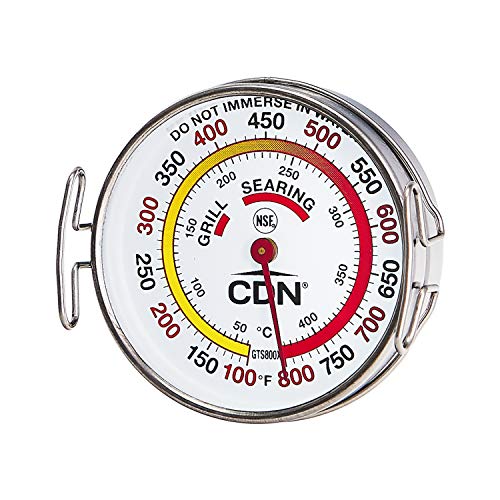
- ✓ Clear color-coded scale
- ✓ Rugged, high-heat build
- ✓ Easy to read on the grill
- ✕ Lacks mounting hardware
- ✕ Basic design, no frills
| Temperature Range | 100–800°F (40–425°C) |
| Scale Type | Color-coded, zone-based temperature scale |
| Lens Material | Laboratory glass lens |
| Application Scope | Grill surface, BBQ hoods, hot/cold spot detection |
| Readout Purpose | Accurate monitoring of grill surface temperature zones |
| Brand | CDN |
The moment I unboxed the CDN GTS800X, I caught a whiff of that clean, lab-style build. You can tell it’s built for real grill days, not just quick meals.
I gave the glass lens a careful wipe, and the color-coded scale immediately drew my eye to the right zones for salmon.
I laid it on the grill plate and watched the numbers climb with the heat. The range from 100 to 800°F means you can chase salmon’s ideal internal temp without guessing.
The color bands make it easy to glance and know if you’re hovering in the safe zone or creeping into higher heat.
What surprised me was how steadily it reads even as the grill gets busy. That laboratory-grade lens is no joke—readings stay crisp, not smeared by steam or fat.
It’s sturdy enough to handle a flame-roast moment without worrying about warping.
Placement matters, and this model lets you decide where to mount or lay it flat for direct contact readings. I found it convenient to slide it under the salmon grill rack to monitor surface temperature as the fish cooked, rather than chasing a probe around.
It’s simple, straightforward, and surprisingly helpful for dialing in crust and juiciness.
If you’re after reliable eyes on your grill surface, this one delivers. It’s not flashy, but it gives you calm confidence during the long, slow salmon simmer-and-sear sessions.
You’ll appreciate the clarity of the scales and the rugged build when you’re juggling multiple pans.
Overall, it’s a practical tool to keep you honest about doneness. For salmon lovers, that precise feedback makes a real difference in texture and flavor.
BBQ Grill Temperature Gauge 2-Pack Thermometer

- ✓ Clear, readable dials
- ✓ Easy mounting
- ✓ Waterproof surface
- ✕ Limited to 2″ dial size
- ✕ Basic plastic packaging
| Dial Size | 2 inch |
| Material | Stainless steel |
| Mounting | Screw thread with wing nut for easy mounting |
| Water/Dust Resistance | Waterproof surface, fog-free |
| Temperature Range | Not specified in description; inferred as grill/oven use |
| Quantity | Set of 2 |
The moment I dug this 2-pack out of the box, I noticed how sturdy the stainless steel fins felt against my fingers. It immediately clicked that these little dials aren’t just for show—the 2″ gauges are easy to read from across the grill deck, and the screw thread with a wing nut makes mounting a breeze.
I dropped one on my kettle grill and the other on a charcoal setup, and the waterproof surface stayed clear even after a light drizzle.
What surprised me is how quickly the temperature readouts settled in. You don’t chase accuracy here—these readouts stay steady as you adjust the vents and manage a two-zone setup.
The 2″ dial is legible in bright sun and at dusk, which is exactly what you need when you’re juggling salmon on the grill and a busy family dinner on the line.
Mounting is straightforward: screw the thread, tighten the wing nut, and you’re done. The gauge’s build feels robust enough to survive a few seasons of grill abuse, and the waterproof surface means no foggy readings when you grab the handle with damp mitts.
It’s not flashy, but it does the job without fuss, letting you keep a closer eye on salmon as you approach that perfect 125-130°F finish.
In real-world use, the two-pack shines when you’re cooking multiple items or sharing one grill across guests. You’ll appreciate the direct readout at eye level while you monitor ambient temps and internal temps without leaning in close.
If you’re chasing precise, repeatable results for salmon, these gauges become a simple, dependable tool you’ll reach for again and again.
All in all, they feel like a small upgrade that actually changes how you grill salmon, without making things more complicated. Simple, rugged, and affordable—exactly the kind of upgrade you’ll keep reaching for.
Escali AHG2 Stainless Steel Extra Large Direct Grill
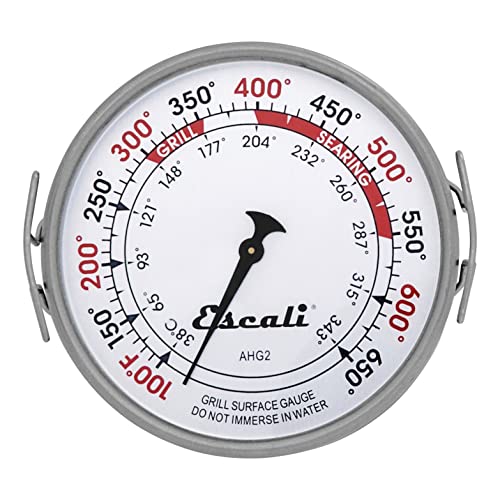
| Temperature Range | 100°F to 650°F (38°C to 343°C) |
| Dial Diameter | 3.5 inches |
| Display Type | Extra-large dial with Fahrenheit or Celsius option |
| Construction Material | Stainless steel |
| Direct-Use On Grill Surfaces | Yes, designed to be left in grill to measure surface temperatures |
| Safety Feature | Safe lift side tabs for handling with fork or tongs |
You know I put the Escali AHG2 Stainless Steel Extra Large Direct Grill to the test right next to a sizzling rack, and it immediately stood out with that extra-large dial. The Fahrenheit/Celsius switch and the bold numbers make quick checks painless, even from across the grill lid, which is a big win when you’re juggling a salmon fillet and skewers at the same time.
The thermometer is built to stay on the grill, and you can really feel the durability as you nudge it with tongs without worrying about misreads. I loved how the thermometer clearly marks the cooking and searing temperature zones, so I could nudge the heat to stay within that ideal range for salmon—between 100° and 650°F—as I tested different sear times. When comparing different best temperature for salmon on the grill options, this model stands out for its quality.
In terms of practical use, the Directly on Cooking Surfaces design means you watch the surface temperature rise and stabilize, which helped me dial in a perfect crust without drying out the fish. Its 3.5-inch dial diameter is generous enough to read at a glance, and the safe lift side tabs kept my hands away from the hot grill.
Oklahoma Joe’s Surface Temperature Gauges – 2‑Pack Grill &

- ✓ Clear, readable faces
- ✓ Easy on/off clip
- ✓ Sturdy, simple design
- ✕ Limited range markers
- ✕ Not wireless/readout
| Measurement Type | Surface temperature gauge for grill |
| Gauge Face Size | 3-inch (76 mm) diameter |
| Temperature Markings | Pre-marked temperatures and ranges for cooking styles |
| Placement Method | Designed to be placed directly on cooking surface |
| Removable Clip Feature | Removable clip to lift with a spatula when hot |
| Pack Size | 2-pack |
The first time I slipped these two gauges onto the grill, I noticed the 3-inch faces immediately—big enough to read without leaning over the sizzling surface. I’ll admit, I wasn’t sure how precise they’d feel, but the marked temperatures gave me a quick sense of confidence as salmon hit the grate.
What sold me is how straightforward the placement is. You set the gauge right on the cooking surface, and the clip makes it easy to lift with a spatula without burning your fingers.
Reading temps at a glance became part of the rhythm of grilling, not a distraction.
Over several salmon cooks, I appreciated the dedicated ranges for different styles. The markings cover the common “lightly cooked through,” “medium,” and “firm” targets, so you’re not guessing when that thin edge is on the verge of overcooking.
It’s a small detail, but it saves you from lifting the lid and pawing at the probe.
The removable clip is a neat touch, especially when you’re flipping with tongs and don’t want the gauge slipping. The stainless build feels sturdy enough to survive a few grates and a busy weekend cookout.
Reading the face in bright sun is fine, and in dusk using a phone flashlight isn’t necessary.
If you’re chasing perfectly salmon with minimal fuss, these gauges respond to that need. They slot into a routine without stealing your attention from the grill.
You’ll find yourself relying on the visible markers more often than you thought you would.
Overall, they’re simple, practical, and built for real-world grilling moments. A small tool that makes big differences in your fish game.
Grill Temperature Gauge BBQ Smoker Thermometer for Charcoal

- ✓ Clear large dial
- ✓ Durable stainless steel
- ✓ Waterproof surface
- ✕ Limited ambient light readability
- ✕ Requires grill access panel space
| Display/Face Size | 2 3/8 inch (large dial face) for easy readability |
| Stem Length | 2 7/8 inches |
| Connection/Installation Surface | Attaches to grill, oven, or oven panel |
| Case Material | Stainless steel |
| Waterproof/Anti-fog Surface | Waterproof dial surface with anti-fog/heat-resistant clarity |
| Temperature Range and Accuracy | 50°F to 800°F with ±2% accuracy |
You lift the grill lid and spot this DOZYANT thermometer staring back at you with a bold 2 3/8″ face. The moment you screw it into the grill panel, the stainless steel housing feels sturdy, and the dial’s reflection looks oddly satisfying as you wipe away a little drizzle of marinade.
I found myself glancing at the readout while the charcoal flames hiss softly—it’s the kind of tool that quietly stays out of the way while you cook.
First salmon took on a subtle glow as I set the dial to a mid-range target. The 50F to 800F range covers everything from delicate fish to big, smoky roasts, and the 2% accuracy is noticeable when you compare it to rough timings.
The stem sits a touch longer than I expected, which made mounting it in a perforated grill lid simpler than I feared.
Installation was straightforward—handy for both a grill and a cabinet panel. The readout remains legible even as the sun dips and the grill heat climbs, thanks to a waterproof surface that won’t fog up.
You can practically read it from across the deck without leaning in, which is a small but real win when you’re juggling tongs and a timing-minder alarm.
In practical salmon-shaping moments, you’ll appreciate the stability of the pointer as the temperature hovers near that ideal 120-130°F finish. It’s easy to clean after you’re done, and the environment-friendly stainless steel body feels built to last through many grilling seasons.
If you’re chasing even more precise control, you’ll still get dependable guidance from this gauge as your fish rests off the grill.
Overall, it’s a trustworthy, easy-to-use companion for charcoal grilling, especially when you’re chasing the best temperature for salmon on the grill. It doesn’t demand a huge setup, yet it delivers clear, actionable readings when you need them most.
What is the Best Internal Temperature for Grilled Salmon?
In practical applications, using a reliable meat thermometer can help achieve the perfect internal temperature. Another best practice is to remove the salmon from the grill when it is slightly below the target temperature, as it will continue to cook from residual heat. Additionally, allowing the fish to marinate before grilling can improve both flavor and moisture retention, contributing to a more enjoyable meal.
Why is Achieving the Right Temperature Important for Grilled Salmon?
Achieving the right temperature is crucial for grilled salmon because it ensures that the fish cooks evenly, remains moist, and develops a desirable texture while minimizing the risk of foodborne illness.
According to the USDA, the safe minimum internal temperature for fish is 145°F (63°C), which helps eliminate harmful bacteria and parasites. Cooking salmon to this temperature not only makes it safe to eat but also helps achieve the delicate flakiness that is characteristic of well-cooked fish. Research published in the Journal of Food Science emphasizes that cooking fish at the correct temperature preserves its natural moisture content, which is essential for maintaining flavor and texture.
The underlying mechanism relates to the proteins in the salmon. When heated, the proteins denature and coagulate, which transforms the texture from raw to cooked. If the temperature is too low, the proteins do not fully denature, resulting in a raw or undercooked center. Conversely, cooking at excessively high temperatures can lead to overcooking, causing the fish to become dry and tough. The Maillard reaction, which occurs at higher temperatures, contributes to the development of complex flavors and a desirable crust. Thus, achieving the best temperature for salmon on the grill involves balancing these factors to create a safe and delicious meal.
How Can You Use a Meat Thermometer to Check Salmon’s Temperature?
The best temperature for salmon on the grill can be accurately checked using a meat thermometer, ensuring perfectly cooked fish.
- Insert the Thermometer Correctly: Place the thermometer into the thickest part of the salmon fillet, avoiding bones and fat.
- Target Cooking Temperature: Aim for an internal temperature of 125°F to 130°F for medium-rare salmon.
- Resting Time: Allow the salmon to rest for a few minutes after grilling to let the temperature stabilize.
- Visual Cues: Look for flaky, opaque flesh as a secondary indicator alongside the thermometer reading.
- Calibration Check: Ensure your meat thermometer is calibrated correctly for accurate readings.
When inserting the thermometer, it’s crucial to ensure that it reaches the center of the fillet where the meat is thickest; this will provide the most accurate reading of the salmon’s doneness.
The ideal internal temperature for grilled salmon is between 125°F and 130°F, which allows the fish to remain moist and tender while still being safely cooked.
After grilling, letting the salmon rest for about 5 minutes helps the juices redistribute, which can enhance flavor and texture.
In addition to using a thermometer, check for visual cues such as the meat turning opaque and flaking easily with a fork, which can indicate that the salmon is cooked through.
Before using your thermometer, it’s advisable to check that it is properly calibrated, as an inaccurate thermometer can lead to undercooked or overcooked salmon.
What Grill Temperature Should You Aim for When Cooking Salmon?
Flipping techniques are essential when grilling salmon; it should generally be flipped only once to maintain its structure and prevent it from breaking apart. After grilling, letting the salmon rest for a few minutes is beneficial, as it allows juices to redistribute, resulting in a more flavorful and succulent dish.
How Long Should You Grill Salmon at the Ideal Temperature?
The best temperature for grilling salmon is typically around 400°F to 450°F, and the cooking time can vary based on thickness and preference for doneness.
- 400°F to 450°F: This temperature range is ideal for grilling salmon as it allows for a good sear while cooking the fish evenly.
- Cooking Time: Salmon should generally be grilled for about 4 to 6 minutes per half-inch of thickness, ensuring it reaches a safe internal temperature.
- Flipping Salmon: It’s recommended to flip the salmon only once to maintain moisture and prevent it from falling apart.
- Using a Meat Thermometer: The best practice is to check the internal temperature, which should reach 145°F for safe consumption, ensuring the fish is fully cooked.
Grilling salmon at 400°F to 450°F allows the fish to develop a flavorful crust while keeping the inside moist and tender. This temperature range strikes a balance between cooking the fish thoroughly and preventing it from drying out.
The cooking time for salmon generally follows the guideline of 4 to 6 minutes per half-inch of thickness. For example, a 1-inch thick salmon fillet should take about 8 to 12 minutes to cook properly, depending on the grill’s heat and the desired level of doneness.
Flipping the salmon only once during the grilling process helps preserve its texture and flavor. If the fish is flipped too frequently, it may break apart, leading to a less appealing presentation and potentially uneven cooking.
Using a meat thermometer is an essential tool for ensuring that salmon is cooked to perfection. The recommended internal temperature of 145°F guarantees that harmful bacteria are eliminated, while also preserving the fish’s natural flavors and moisture.
What Types of Salmon are Best for Grilling at Specific Temperatures?
The best types of salmon for grilling vary based on their fat content and texture, affecting how they perform at different temperatures.
- King Salmon: This type is known for its high fat content, making it incredibly rich and flavorful. Grilling King salmon at a temperature around 350°F allows the fat to render nicely, keeping the fish moist while developing a delicious char on the outside.
- Sockeye Salmon: Sockeye is leaner than King salmon but has a robust flavor that holds up well on the grill. Grilling at a medium-high temperature of about 375°F is ideal, as it cooks quickly while still achieving a crispy skin and maintaining the tender flesh.
- Coho Salmon: Coho salmon has a milder flavor and a moderate fat content, making it versatile for grilling. The best temperature for grilling Coho is around 325°F, allowing it to cook evenly without drying out, resulting in a flaky texture and enjoyable taste.
- Pink Salmon: This type has the lowest fat content and is often used for canning or smoking, but it can still be grilled. It’s best cooked at a lower temperature of 300°F to prevent it from drying out, ensuring it remains moist and tender while developing a light smoky flavor.
- Chum Salmon: Chum salmon is often less fatty but has a firm texture that can be successfully grilled. Cooking it at a temperature of about 325°F allows it to achieve a nice sear while retaining moisture, making it a good option for grilling with marinades or spice rubs.
What Common Mistakes Should You Avoid When Grilling Salmon?
When grilling salmon, avoiding certain common mistakes can significantly enhance the flavor and texture of your dish.
- Not Preheating the Grill: Failing to preheat the grill can lead to uneven cooking and sticking. It’s essential to allow your grill to reach the ideal temperature before placing the salmon on it to ensure a nice sear and prevent it from falling apart.
- Using the Wrong Temperature: Cooking salmon at too high or too low a temperature can result in dry or undercooked fish. The best temperature for salmon on the grill is around 375°F to 400°F, which allows for thorough cooking while retaining moisture.
- Skipping the Skin: Many cooks make the mistake of removing the skin from the salmon before grilling. Leaving the skin on helps protect the fish from the direct heat and adds an additional layer of flavor, while also making it easier to flip without breaking.
- Overcooking the Salmon: Salmon can go from perfectly cooked to dry very quickly, so it’s crucial to monitor its internal temperature. Aim for an internal temperature of 145°F; using a meat thermometer can help ensure accuracy and prevent overcooking.
- Not Using Enough Oil: Insufficient oil can lead to sticking and tearing of the salmon. Brushing the salmon with oil not only helps it to release easily from the grill but also enhances the flavor and helps achieve a crispy exterior.
- Ignoring Marinades and Seasonings: Some people underestimate the importance of seasoning their salmon before grilling. A good marinade or seasoning blend can elevate the dish, adding depth and enhancing the natural flavors of the fish.
- Flipping Too Soon: Many grillers are tempted to flip their salmon too early, which can cause it to break apart. Allowing it to cook undisturbed for several minutes before attempting to flip will help develop a nice crust and make it easier to handle.